Ralph–Piggy relationship
Lord of the FliesRalph and Piggy’s relationship begins with a breach of confidence and grows into a partnership neither boy can quite make equal. Ralph has the appearance and authority to lead on The island; Piggy sees problems clearly and tries to make plans work. Ralph repeatedly depends on Piggy’s intelligence, yet initially treats his wishes and dignity as expendable. As the boys’ social order deteriorates, this imbalance becomes more dangerous: Piggy’s reliance on Ralph is personal as well as political, while Ralph increasingly needs the practical judgment he once dismissed.
An Unequal Introduction
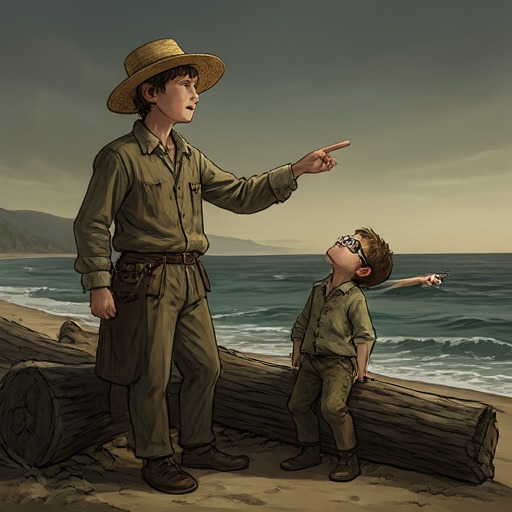
Piggy approaches Ralph with an instinct for organization. After explaining that the other boys should be named and counted, he proposes making a list and holding a meeting. Ralph does not immediately take up the suggestion, leaving Piggy to press the point. Their difference is apparent from the outset: Piggy thinks in procedures, while Ralph can command attention without having to argue for it.
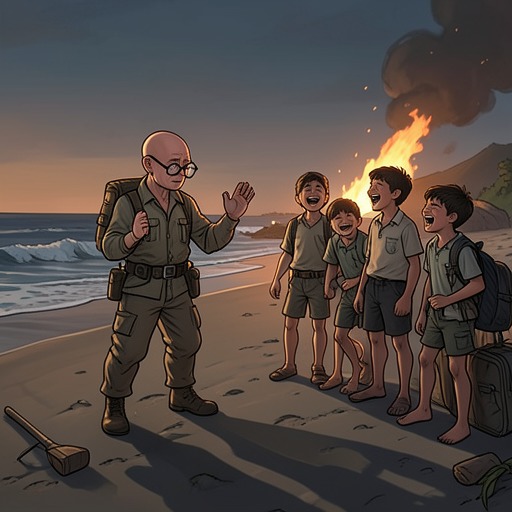
The first intimacy between them is also the first injury. Piggy confides that his schoolmates called him Piggy and asks Ralph not to tell the others. Ralph responds with laughter, repeats the nickname, and turns the disclosure into a joke. Piggy is pleased to have Ralph’s attention even while trying to stop him, an uncomfortable mixture that sets the pattern for their bond: recognition from Ralph matters to Piggy, but Ralph can grant or withdraw it without first understanding its cost.
When Piggy offers to join Ralph, Jack Merridew, and Simon on their expedition, both Ralph and Jack reject him. Ralph tells him he is no good for the job; Jack makes clear that the three are enough. Piggy reminds them that he was with Ralph when Ralph found The conch and that he had been there before anyone else, but this claim of closeness does not secure him a place. Ralph leaves Piggy behind with the task of taking names. Only after Piggy protests that Ralph has exposed the nickname he had asked him to keep secret does Ralph recognize how deeply he has hurt him. His apology is qualified by the suggestion that Piggy is better off with that name than another insult, and he moves quickly to assigning Piggy useful work. The episode shows both a capacity for regret and the limits of Ralph’s attention to Piggy’s feelings.
Leadership, Work, and Dependence
The boys’ later responsibilities make the differences between them consequential. Ralph struggles to keep the group focused on shelters and the signal fire, while Piggy insists on orderly work and on paying attention to the youngest boys. When the first fire burns out of control, Piggy argues that the boys have rushed to make a bonfire without first building shelters, and that nobody has reliably counted or watched the little ones. Ralph answers that he had told Piggy to make a list, but Piggy explains that the boys scattered before he could do it. Their exchange exposes a shared failure of coordination, though Ralph initially responds by blaming Piggy for a task the group made nearly impossible.
Ralph’s understanding of Piggy changes as the practical burden of leadership grows. At an assembly, he recognizes that Piggy can think through a problem step by step, even though Piggy is not the boy the others choose as chief. Ralph’s authority and Piggy’s judgment are different kinds of power: one draws obedience, the other makes sense of what has gone wrong. Ralph can see this distinction more clearly than he can consistently act on it.
Their disagreement over the shelters and hunting makes that dependence a source of tension. Ralph has been working with Simon while the other boys leave their tasks; he wants Jack Merridew and the hunters to help finish the shelters. Jack is absorbed by tracking and killing a pig, and argues that the group needs meat. Ralph insists on shelter, especially with fear troubling the boys at night. Piggy’s concern for practical needs belongs to Ralph’s side of this argument, while Jack’s hunting offers a competing claim on the group’s attention. Ralph must try to govern without the force or popularity Jack can draw from hunting, and Piggy’s reasoning does not by itself make the others follow.
Mutual Reliance Under Pressure
When Jack Merridew openly challenges Ralph’s leadership, Piggy becomes more than a frustrated adviser: he helps Ralph understand the threat. After Jack’s attempt to turn the boys against Ralph fails, Piggy identifies the personal rivalry beneath their conflict. He tells Ralph that Jack hates him because Ralph is chief and because Ralph prevailed over him around the fire. Piggy also recognizes that Jack’s hostility may fall on him if Ralph is no longer there to draw it away. His analysis is not detached speculation; it expresses his fear of being exposed to Jack’s power and his dependence on Ralph’s protection.
Ralph, in turn, cannot simply dismiss Piggy’s judgment. During the disorder following the failed assembly, he hesitates to use The conch because the boys may not return, and because their refusal would show how little authority remains. Piggy argues that failing to call them would bring the group closer to behaving like animals. At another moment Ralph admits that he is frightened not only of the beast but of the possibility that he too will stop caring about the signal fire. Piggy can answer only that they must continue, but Ralph has turned to him to speak through a fear that his position as chief does not resolve.
This reliance does not make them equals, nor does it erase their conflict. Piggy’s presence can be a liability to Ralph among boys who reward hunting, courage, and physical force; Ralph sometimes joins the group’s laughter at Piggy or leaves him outside decisions. Yet Ralph also knows that Piggy’s intelligence is unusually dependable. The relationship repeatedly draws Ralph toward the very person he has helped marginalize: he needs Piggy’s clear thought even when the group treats Piggy as someone whose speech and body can be ridiculed.
The Conch and the Final Appeal
After the raid that takes Piggy’s glasses and leaves the signal fire unavailable to Ralph’s group, Piggy turns his humiliation and fear into a plan. He will go to Jack Merridew carrying The conch and appeal not for a favor but for what is right: the return of his glasses. Piggy knows that he cannot see properly without them, and that he will have to be led. Ralph warns that Piggy may be hurt, but agrees that they will go with him. He also lets Piggy carry the shell, an act that briefly places Piggy at the front of their appeal rather than assigning him a task from behind.
At Castle Rock, Ralph tries to demand the glasses and explain why the signal fire matters. When Jack Merridew orders Sam and Eric seized, the challenge to Ralph’s authority becomes physical. Piggy remains concerned with the purpose of the visit—the fire and his glasses—while Ralph is drawn into the confrontation. Their attempt to make a claim through The conch and the language of rules cannot protect them from a group that has stopped recognizing those claims.
Piggy is killed when Roger sends a boulder down upon him, and The conch is destroyed in the same moment. Ralph is present; his lips form a word, but he cannot make a sound. That silence marks the severing of a relationship as well as the collapse of the order the boys had tried to preserve. Ralph has lost the companion whose reasoning he increasingly depended on, while Piggy’s final journey to confront Jack had been undertaken with Ralph beside him. Their history remains unresolved: the boy who first made Piggy’s private shame public comes, at the end, to share the danger of Piggy’s appeal, but their belated solidarity cannot restore either Piggy or the authority represented by The conch.